
Go Johnnie Go…the life we’ve lived
 Johnnie, stripped of his clothes and shoes, was running naked as a jaybird, stepping on prickly pears, blood running from his nostrils as it does with racehorses when extreme exertion causes the lung tissue to hemorrhage. Basically Johnnie was trying to escape from the maw of death. I suppose we all have made runs such as this, in some form, at some point in our lives. A run of shame, a hasty

Cabrini Green
yet nimble retreat down rickety back stairs; a young, clothes clutching lad, who was running towards his certain demise at the Cabrini-Green public housing project in Chicago, scooped up by a haloed, trash truck driving savior; the tire iron and croquet mallet wielding miscreants chasing an innocent Dodger fan through the parking lot of Jack Murphy stadium. These events are all too common in this day and age where unshirted zealotry is coupled with a bovine lack of curiosity, where imaginations are used more than memory, and where charm and reliability rarely come in the same package .
 But Johnnie’s issues did not come from this day and age. Johnnie Colter’s issues were from 1808 when this fur trapper, mountain man extraordinaire, member of the Lewis and Clark expedition, and first person of European descent to enter the region now known as Yellowstone National Park, met up with some Blackfoot Indians in a liverish mood. While canoeing up the Jefferson River he and his partner John Potts ran into several hundred Blackfoot who motioned them to the side of the river. Johnnie went ashore where he was forced to nude up by the Indians, but Potts tried to get away.
 He was riddled with arrows like a sewer’s pin-cushion and his body was brought to shore where it was hacked to small pieces. Johnnie thought his fate was going to be the same as his buddy Potts, but no. The chief, after much council, thought he would make a game of it. Telling Johnnie to dash, it all became clear – John Colter was in for the run of his life. He was given a two hundred yard head start then chased by 300 young warriors full of menace. Johnnie had to hear their horrid war whoops closing in behind him and probably thought he had as much chance to outrun the young bucks as Donna Summer did getting into the
  Rock-n-Roll hall of fame (actually she made it in 2013 ….so weird.) He looked back and saw that the chasing Indians had scattered and he had gained ground on the main body of his pursuers with the exception of one brave who was within 50 yards. By this time he had run 6 miles and could still hear the footsteps close behind him.
Suddenly Johnnie stopped, turned around, and spread his arms. The Indian, totally surprised by the  suddenness of his action, and perhaps because of Johnnie’s bloody appearance, also came to a halt, but tripped and fell to the ground, his spear breaking at the blade. Johnnie grabbed the blade section and impaled the Brave onto God’s good earth. The trailing Indians saw what occurred and increased their pursuit with renewed vigor and vengeance.
Johnnie ran like few of us ever have, eventually jumping into the freezing Madison River, where he hid in cottonwoods  and beaver dens to survive. He walked, climbed high snow covered peaks, and ran for eleven more days, usually at night, until he finally arrived at a trading post on the Little Big Horn. His life had been won. In the end the wild life of the Mountain Man lost its attraction, and Johnnie fell back to St. Louis where he found his wife and found his last days.
We all have friends like Johnnie who are bold with adventure, who percolate in their own vitality – and we are better for them. We all have friends that have found themselves in difficult situations (usually self made) where things could have gone terribly wrong, but now are just good stories.  Some have been forced to run for their lives, either figuratively or literally, and their thunder-clap stories enhance us and shield us from the winds of normalcy. So let us toast to the gallant, to the foolish, to those who defy slumber, to those with affections and afflictions, to those who shirk the mundane, to those who bring smiles and head shakes to us with their exploits. So here is a toast to Johnnie Colter and to our wonderful friends. Groove










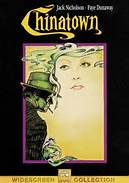 It is true that screen writer Robert Towne (Shampoo, the Last Detail ) wrote the screen play for ” Chinatown ” at the Banning House Lodge at the Isthmus on Catalina Island, California. It is true that the Ford Thunderbird, the low, stylish two-seater iconic car of the 50’s, was named after the Thunderbird Country Club in Rancho Mirage,
  California . The country club was also the first place that golf carts were used, invented by assistant pro Eddie Susalla. It is also true that during World War II, the casualty rate for every 1000 US Army soldiers in uniform was 24, for the US Marines there were 29 casualties for every 1000, and for the US Air Corps it was a startling 400 of every 1000 bomber crew members that were casualties. The average age of a typical US soldier in WW2 was 26 (in Vietnam it was 19) born in the year that the war to end all wars ended (World War I, 1918). He weighed 144 pounds and was 5’8″. One in three only had a grade school education, one in four held a high school diploma, and one in ten attended college for at least one semester. This is all true.
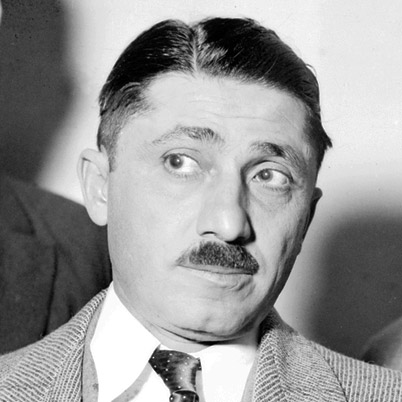
 But what is not true is that Fast Eddie O’Hare turned in his client Al Capone to the Feds and the IRS because he wanted his son Butch to learn the value of honesty and integrity. There have been attempts to tell this tale as a story of redemption and a morality play to demonstrate the importance of recognizing the errors of one’s ways, of atoning for one’s misdeeds, of trying to do right and prevent one’s sins from being visited upon future generations. All valuable lessons indeed, but they have little to do with the true story of Fast Eddie, Ursula (Eddie’s fiance), Eddie’s son Butch, and Al ” Scarface” Capone.
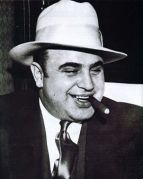 Chicago night life was doing him favors. Eddie hooked up with Ursula Sue Granata whom he planned to marry, but being a good Catholic lad he couldn’t pull the marriage trigger because of the divorce, which made Ursula none too happy. Eddie sent a lot of dough to the Vatican in hopes that a request for a dispensation would come through, but Eddie had to keep on waiting. Eddie was rolling in the green doing legal work for Al and sharing in the huge profits from these less than noble activities. Besides dancin in the dough, living the highlife with Ursula, and groovin with Big Al, Eddie was also an adoring father to his son Butch who he tried to give all the best things in life.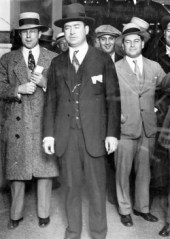

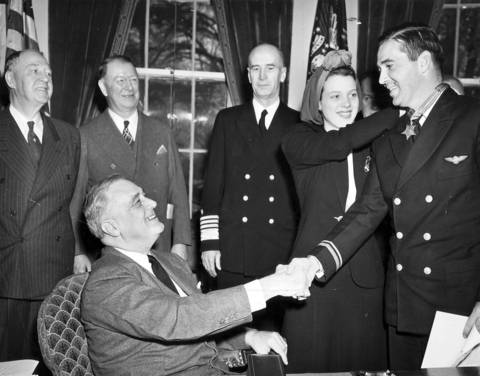


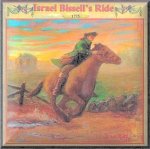 Talk about getting burned. Nobody got more toasted than Israel Bissell. And who was this fine gentleman? No, not a “Jewish Vacuum Cleaner”, but a postal rider from Massachusetts who on April 19th, 1775 took off from Watertown, Mass. and for four days through five states Izzy warned the colonists of a invasion by the
 sense of urgency and a call for action. History favors the courageous (as does eating: first guy to eat a clam or a lobster ) and Hank wanted to get the word out and stir up the pro-union sentiments. (Don’t know how much Hank Longfellow stirred us with ” Song of Hiawatha ” except to make us drink more Hamm’s Beer.) So Longfellow wanted to write a poem that would capture his opinion and capture this “hour of darkness and peril and need.” The problem was that the name Israel Bissell just didn’t have the rhyming scheme nor the flair of Paul Revere. Remember that Hank is writing this poem some 85 years after the ride and people sort of forgot how it all went down. Even when Paul died in 1818 there was no mention in his obit about “His Historic Ride” just that he had a good business sense, made nice silver punch bowls, and was a cool guy.
 really who could forget “Kicks” or “Indian Reservation ( the lament of the Cherokee Reservation Indian)” and what does Israel Bissell get? Maybe a country named after him or a vacuum company, but that’s a big reach. Perhaps just that we know Israel Bissell was a cool patriot and let’s think, what rhymes with Israel Bissell? Groove.
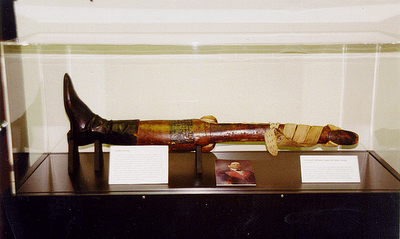
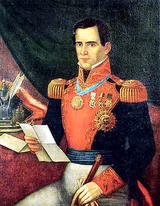 Black Pantheon of Guys who failed their Nation: Antonio de Padua Maria Severino de Santa Anna y Perez de Lebron, also known as Santa Ana or perhaps in some circles as just Santa. This guy lived a crazy political life having been named President of Mexico eleven non-consecutive times and was still at the end of his life, ready for a come back (we thought Bret Farve was bad). He was the man in charge at the massacres at the Alamo (189 Americans killed including Dave Crockett and Sam Bowie) and at Goliad (executed 342 Texas prisoners) all in 1836. Joel Pointsett (the first US minister to Mexico) called Santa Ana a “polecat in silk clothing” (Joel was an amateur botanist and would send back to the states the beautiful red flowered plant that now graces his name : the Pointsettia.) A month after his wife died, Santa, now 50, married a 15 year old and attempted many coups and presidential runs, but after eleven shots in the high office the good people of Mexico had had enough. He was forgotten and unloved.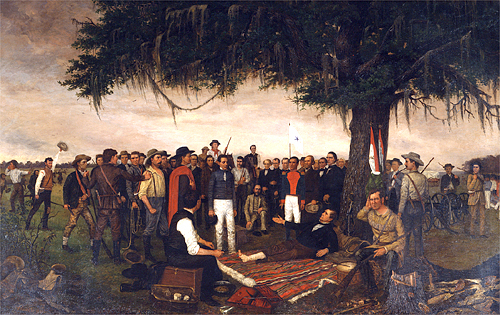

 tried to make toys, masks, rain boots, and bike tires out of the material, all failures. Preparing to dump the chicle into the East River, Adams popped a piece into his mouth and liked the taste. Chewing away, he had the idea to add flavoring to the chicle. Shortly after, he opened the world’s first chewing gum factory and in February of 1871, “Adams New York Gum No.1” went on sale in drug stores for a penny a piece. He then added “Chic-lets,” “Black Jack,” and “Tutti-Frutti” to his line and was the first gum to be sold in vending machines. During the next year, Thomas Adams formed the “American Chicle Company” which merged the 6 largest chewing gum manufacturers and remained on its board of directors until he died in 1905. In America, over 195 million pounds of chewing gum is consumed annually.

 deft hands to create a superbly delicate compound as a prelim liquid that would send us off into the evening. Rum, which is the pillar of Daiquiris goodness, is a dangerous agent which bows to the power of a contemptuous indifference to fate, sets the mind and body free of responsibility, obliterating memory of today and tomorrow, gives an adventurous feeling of superiority, vanquishes all fears and doubts, and in some cases allows the consumer to change his name, or at least add a new one. Could a liquid be any finer ?
 Grog, which is basically rum diluted by water with occasional citrus to prevent scurvy, is associated with the bad boys of the seas: Pirates. But in reality, Grog came well after the Happy Days of the likes of Capt. Morgan, Blackbeard, and other pirates. In 1740, the British Navy would issue a daily dram of grog as a moral booster to the swabs and it was unknown what was the strength of the concoction. The Sikes hydrometer, which measured alcohol content, was invented in 1816, but prior to that the alcohol content was determined by mixing the spirit with a few grains of gunpowder then subjecting the grog to the focused rays of the sun under a magnifier. If the gunpowder managed to ignite, but the liquid didn’t flare up, this was “proof” of its proper alcohol content. Even diluted, the grog ration was the equivalent to about five cocktails per day and by the 1950s only a third of the British sailors took advantage of their grog tot. As naval operations became more
  complex with computers and missile systems, the daily grog rations made less sense than when all the sailors had to do was haul around buckets of tar. Finally, on July 31, 1970, what is known in British naval circles as Black Tot Day, the final ration was given to the British sailors. With black arm bands, heavy hearts, and a 21 gun salute – the Grog rations were over after 325 years.
 Capt. Morgan rum is the number 2 rum in the world (Bacardi number 1) which accounts for one-third of the billion dollar rum market. It was introduced in the U.S. all the way back in 1949 by Seagrams and is now owned by Diageo which is the largest producer of liquior in the world. Other Diageo brands include the best selling vodka in the world Smirnoff, the two top Scotches Johnnie Walker and J&B , the leading stout Guinness, and the number 1 liqueur Baileys Irish Creme. The ten largest producers of booze in the world own 70% of all liquor brands and that concentration is sure to rise.








 GrooveCentralLA