
Here’s a toast to our friends the Cool Cats (Gangsters) and Kittens (Prostitutes)
 I always thought I would be a better gangster than a spy. The spy thing is too much sneaking around in a trench coat trying to lurk in the shadows of the night. Always vulnerable, like a puppy on an iceberg, a spy often is a traitor and who wants to groove with a traitor? Gathering information, creeping around, perhaps your shoe is an intercontinental ballistic missile (better than “his bow-tie is really a camera”), not that fun – just not a good line of work. Not to say that being a gangster is any day at the beach. Most die young and violent deaths without the joys of friends nor family. But both our pals the gangster and his good friend the prostitute, brought some of the common sense and good times that we all enjoy today.
The “Gangster Golden Era” really lasted just three years from 1933 to 1936. This was also the era of the FBI’s “War on Crime”. The FBI started out as a bumbling band of overmatched amateurs who initially didn’t even carry firearms. J. Edgar’s boys lost suspects, botched stakeouts, and repeatedly arrested the wrong men. Their mistakes would be comical if not for the price paid by the innocent.
 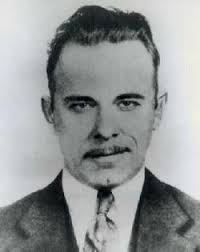 During that three-year period we saw the rise and fall of John Dillinger (definitely a cool cat…the chicks dug him), Baby Face Nelson (a real unstable psycho, killed to boost his ego and did have a baby face), Machine Gun Kelly (real name George Barnes, dumb as a sack of nails, his wife nagged him into a world of crime), Pretty Boy Floyd (was not pretty, but was cool enough to have Woody Guthrie write a song about him), the
 Barker/Karpis gang (Ma Barker was a dim-witted old hag who loved to put together puzzles, it was J. Edgar who portrayed her as a “mastermind,” her own gang said “she couldn’t plan breakfast”), and Bonny and Clyde (no Warren or Faye here, largest haul was $3500, killed innocent bystanders, were incompetent and careless. She was 23 and Clyde was 25.)
There is one cat that needs to be further mentioned. Picture this: it is 1979 and you were on the Spanish coast in a town called Torremolinos. You look  over at the table next to you and there was a seventy year old Alvin “Creepy” Karpis still lean and alert looking more like a professor then the last of the FBI’s Public Enemy No 1’s. Creepy (his friends called him Ray) was captured in 1936 and according to Creepy, Hoover approached him only after other agents had seized him. Hoover said “Put the cuffs on him.”, but no one brought any, so they had to use one of the agent’s ties. During his life time he ran with Baby Face Nelson, knew
  Bonny and Clyde, was the longest-serving prisoner on the Rock (Alcatraz), for a long stretch of 26 years. He knew the Birdman, and that gas-bag Machine Gun Kelly, and saw Capone flop around on the cafeteria floor like a large mouth bass on the cutting board while in one of his syphilitic seizures. In 1962, while in the process of closing Alcatraz, Creepy was transferred to McNeil Island Penitentiary in Washington state. There he was approached by a little punk who wanted guitar lessons. “He was meek and mild and never said a harsh word to anybody ” said Creepy. Charlie Manson went on to his own fame, but not by playing the guitar. Creepy was released in 1969 and died in Spain ten years later of an accidental overdose of pills and booze.
As far as our friend the gangster and organized crime is concerned, they brought us many things that we enjoy today: jazz music (Al Capone, whose jazz  clubs in Chicago introduced jazz to mainstream America, and according to black singer Ethel Waters “treated her with respect, applause, deference, and paid in full.” He and other gangsters, including the great Owney Madden of Cotton Club fame, supplied steady and professional incomes to jazz musicians who had previously lived in poverty.), alcohol (prior to Prohibition a woman rarely
 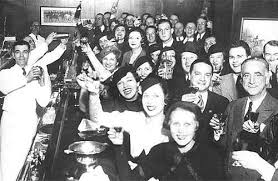 drank in public unless she was a prostitute. The “Speakeasys” changed that because women were welcomed there), Las Vegas, Broadway (Arnold “The Brain” Rothstein, who is credited for turning organized crime into big business, financed several Broadway venues, such as the famous Selwyn Theater, as well as various productions that brought tens of thousands of patrons to the “Great White Way”) the establishment of many of the gay and lesbian bars in America (Where there is dough you will always find the “Goodfellas”, Vito Genovese and Carlo Gambino, leaders of two of the most powerful crime families in America. They began investing in gay clubs in the 1930’s. The famous Stonewall Inn was owned by three associates of the Genovese family. The family funded the gay pride parades in New York City which have become an annual event demonstrating sexual freedom.)
 And look what our lovely street walking friends brought us: in the 19th century, if a woman owned property, made high wages, used birth control, consorted with men of other races, danced, drank, walked alone in public, wore makeup, perfume, or stylish clothes, chances were she was a prostitute. In fact, prostitutes won virtually all of the freedoms that were denied to women, but are now taken for granted.
So you see, a lot of good comes from the bad. I think our pals the gangster and the prostitute deserve a toast next time you have a drink in your hand, but perhaps not in loud tones. Who knew that so much freedom and groove would be handed to us along the dark path of those who do dark deeds? Raise a glass to those who came before us and let us not take these freedoms for granted. Groove.
I stole shamelessly from two excellent books : A Renegade History of the United States by Thaddeus Russell and Public Enemies by Bryan Burrough. Thanks fellas.
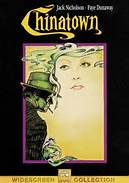 It is true that screen writer Robert Towne (Shampoo, the Last Detail ) wrote the screen play for ” Chinatown ” at the Banning House Lodge at the Isthmus on Catalina Island, California. It is true that the Ford Thunderbird, the low, stylish two-seater iconic car of the 50’s, was named after the Thunderbird Country Club in Rancho Mirage,
  California . The country club was also the first place that golf carts were used, invented by assistant pro Eddie Susalla. It is also true that during World War II, the casualty rate for every 1000 US Army soldiers in uniform was 24, for the US Marines there were 29 casualties for every 1000, and for the US Air Corps it was a startling 400 of every 1000 bomber crew members that were casualties. The average age of a typical US soldier in WW2 was 26 (in Vietnam it was 19) born in the year that the war to end all wars ended (World War I, 1918). He weighed 144 pounds and was 5’8″. One in three only had a grade school education, one in four held a high school diploma, and one in ten attended college for at least one semester. This is all true.
 But what is not true is that Fast Eddie O’Hare turned in his client Al Capone to the Feds and the IRS because he wanted his son Butch to learn the value of honesty and integrity. There have been attempts to tell this tale as a story of redemption and a morality play to demonstrate the importance of recognizing the errors of one’s ways, of atoning for one’s misdeeds, of trying to do right and prevent one’s sins from being visited upon future generations. All valuable lessons indeed, but they have little to do with the true story of Fast Eddie, Ursula (Eddie’s fiance), Eddie’s son Butch, and Al ” Scarface” Capone.
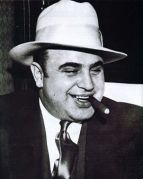 Chicago night life was doing him favors. Eddie hooked up with Ursula Sue Granata whom he planned to marry, but being a good Catholic lad he couldn’t pull the marriage trigger because of the divorce, which made Ursula none too happy. Eddie sent a lot of dough to the Vatican in hopes that a request for a dispensation would come through, but Eddie had to keep on waiting. Eddie was rolling in the green doing legal work for Al and sharing in the huge profits from these less than noble activities. Besides dancin in the dough, living the highlife with Ursula, and groovin with Big Al, Eddie was also an adoring father to his son Butch who he tried to give all the best things in life.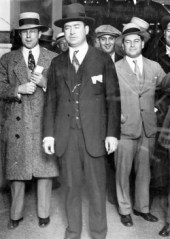


 GrooveCentralLA